
The Advanced RV Energy System
Off-Grid Freedom Starts with Stored Energy
You’ve been driving for 6 hours. You’re exhausted after a day of hiking, but the thought of the upcoming view keeps you going. It’s the middle of summer, and every campground is full, but that doesn’t matter. A friend told you about a little remote spot at the river bend – that’s where you’ll stay the night.
When you arrive, you deploy the hydraulic levelers and take in the scenery. You made it in time for the sunset. You’re sweating – it’ll be hot all night – but you’re peaceful and comfortable. Your RV has more than enough power to run the AC all night.
People travel in Advanced RV Class B Motorhomes because they have a particular sense of adventure that can’t be satisfied by being tied down or plugged in. They want to be nimble, flexible, and comfortable too.
Advanced RVs are designed to travel comfortably without depending on traditional campgrounds, shore power, or a generator. The battery system is what makes that possible. It supports the way owners actually travel. They stay overnight anywhere they want, running appliances, using climate control, charging devices, and moving on without needing any traditional RV hookups.
Since the beginning, ARV has avoided propane and leaned into lithium electrical systems, instead of relying on heavy lead-acid or AGM battery banks. Lithium made more usable energy possible, with discharge longer life, and better performance. ARV’s current battery system is the result of many iterations, service experience, owner feedback, and changing technology over nearly 15 years of building custom motorhomes.
The most common ARV battery system is a cohesive, UL-Listed, 16.8 kWh battery system designed for new builds and upgrades. It is the system going into new ARVs, and it is the system owners of decade-old ARVs are coming back to install. Battery technologies evolve quickly, and a well-built ARV can keep improving over time.

How ARV’s Energy System Works
The ARV energy system has three major jobs: store energy, recharge energy, and deliver energy to the parts of the motorhome that need it.
The house lithium battery stores the energy. A high-output secondary alternator, mounted at the chassis engine, recharges the house battery whenever the engine is running.
That means an Advanced RV does not need to depend on solar, a generator, or regular campground hookups to stay powered.
You can plug into shore power when it is available (like electrical connections at campgrounds), but the system is designed so that travel itself becomes the primary way the battery recovers. That is why many ARV owners spend long stretches on the road, without planning their days around electrical hookups.
16.8 kWh Lithium Battery Capacity
Kilowatt-hours (kWh) are a way to measure stored energy. More capacity means more ability to run lights, outlets, appliances, heating/cooling systems, and other house functions while off-grid.
To understand what capacity means in real life, we can look at what different appliances ask from the battery.
Watts measure how much power something is consuming in a given moment. For example, a rooftop RV air conditioner running on a hot summer day might consume about 1.2 kilowatts of power (1,200 watts).
A 16.8 kWh battery system means that the battery has enough stored energy to run a 1.2 kW air conditioner for about 14 hours.
16.8 kWh ÷ 1.2 kW = about 14 hours of runtime.
Why measure in kilowatt-hours instead of the common amp-hour terms commonly used in RV conversations?
Kilowatt-hour numbers are a more direct metric because a single number describes the total stored energy. Amp-hours can only tell total stored energy when voltage is included. Most traditional RV battery systems operate at 12 volts, so the amp-hour terminology can be consistent – but a 350 amp-hour battery at 48 volts stores far more energy than a 350 amp hour battery at 12 volts. ARV’s 48 volt battery is roughly equivalent to 1,400 amp hours when compared to traditional 12-volt RV batteries.
So, why 48 volts?

48 Volts Batteries are Lighter, Smaller, and Faster
Advanced RVs have evolved from 12 volts to 48 volts because higher voltage lets the system move the same amount of power with less current.
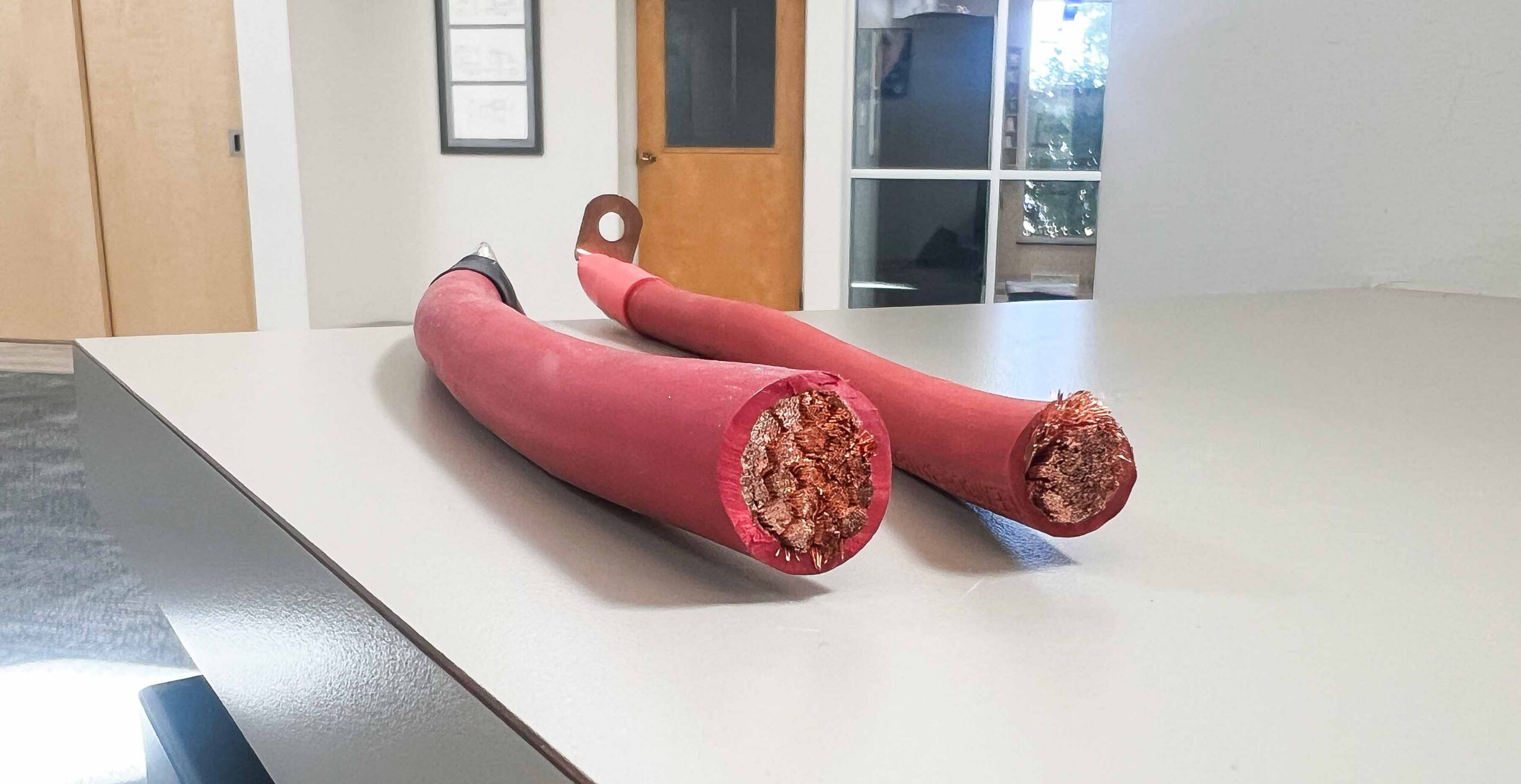
A lower current system, running at 48 volts, can use smaller wiring and lighter components while still delivering the power needed for air conditioning, cooking, outlets, controls, and charging.
For example, a 1,200-watt load needed about 100 amps at 12 volts. At 48 volts, that same 1,200-watt load needs about 25 amps.
That reduction in current makes ARV’s 48 volt battery system lighter, smaller, cleaner to package, and faster to recharge. Even the wires that carry the 48V volt power are smaller.
The smaller package matters dimensionally as well. Because the temperature-controlled battery enclosure is often mounted outside the vehicle, reducing its size helps it sit more tightly against the underside of the chassis. That improves ground clearance and departure angle when compared with a larger, bulkier battery in the same location.
The 48 volt platform also supports one of the most important parts of the ARV travel experience: fast recharging from the engine while you drive.
The smaller package matters dimensionally as well. Because the temperature-controlled battery enclosure is often mounted outside the vehicle, reducing its size helps it sit more tightly against the underside of the chassis. That improves ground clearance and departure angle when compared with a larger, bulkier battery in the same location.
The 48 volt platform also supports one of the most important parts of the ARV travel experience: fast recharging from the engine while you drive.
Recharge While You Travel with the Secondary Alternator
In an Advanced RV, the house battery is charged by a high-output secondary alternator mounted at the Mercedes-Benz or Ford (or other chassis) engine. This alternator charges the battery while you drive.
The current 16.8 kWh 48V battery system, charged by the current 5.6 kW alternator, can charge from empty to full with only a couple hours of driving. ARV travelers do not have to plan every stop around shore power. A drive to the next town, trailhead, or overnight spot becomes part of the recharge cycle.
Advanced RVs also have functions that can charge the battery, off-grid, when the vehicle is parked for a longer period. The chassis engine can run at charging speed while stationary, helping maintain the house battery when loads like air conditioning are important. This is useful when in hot weather, especially when a pet may be resting inside the vehicle relying on the air conditioner.
Other Components: Inverter, Converter, Shore Power, and Battery Maintainer
A number of components convert and manage the energy from the battery for different parts of the motorhome.
Many familiar appliances use 120V AC power, similar to a house. Wall outlets, induction cooktops, microwaves, and some air conditioning systems depend on that kind of power. In an ARV motorhome, the onboard inverter takes the stored battery energy and converts it into 120V AC power so those appliances can operate while the motorhome is off-grid.
The inverter is also equipped with a charger, which works in the other direction. When the motorhome is plugged into shore power, it charges the battery system.
Because ARV’s battery system is 48V, the system also uses an onboard converter to step power down to 12V for components that still require 12V power, like the fridge, freezer, and lights.
ARVs can still charge by shore power when you want it. At a campground, home garage, or other suitable power source, plugging in can run the vehicle’s electrical loads and charge the battery. An onboard surge protector protects the system from unsafe or irregular incoming power before it reaches sensitive equipment.
The system also includes a chassis battery maintainer, which uses the house battery system to help keep the vehicle’s chassis battery charged. This maintainer supports long-term usability and ensures the vehicle stays ready to go.
Easy to Use as Conditions Change in All Four Seasons
The ARV system is designed around a single touchscreen interface that gives owners clear visibility into key information like state of charge, real-time energy use, and system status.
That same visibility helps our technical support team. The interface gives ARV technicians detailed information that can be useful for troubleshooting, including cell-level charge and temperature data.
The steel battery enclosure also includes electric heaters to support cold-weather operation. ARV owners travel across seasons, climates, and elevations.
Built, Tested, and Protected as Complete System
The battery system is designed to be supported by the ARV team for a lifetime of travels.
No matter where a client is, when they have a question or an issue, they start with a phone call to our technical staff. Many issues can be diagnosed remotely or at a nearby service partner.
This long-term relationship is one reason clients are choosing to upgrade older ARVs with the latest battery system. Even the first ARVs, almost 15 years old, are returning for major electrical upgrades because the chassis, cabinetry, and structural craftsmanship are still worth investing in.
Technologies change, travel needs change, but a well-built motorhome can endure years of adventure and improve over time.
Designed for Service and Upgrades
The battery is built as a complete system. Individual cells are assembled into an integrated battery pack, managed by a battery management system, protected inside a steel enclosure, and designed around the space, weight, service, and travel demands of an adventuring Class B motorhome.
The battery is UL-listed, the highest third-party standard for safety, testing, packaging, protection, and reliability.
More Freedom, Fewer Hookups
For new clients, the battery system is part of building a motorhome around the way you actually want to travel.
For current ARV owners, it may also be an opportunity to bring an older vehicle forward with the latest technology.
If you are interested in a new build or want to discuss a battery upgrade for your current ARV, we would be happy to talk with you.